Application Guide
Rules
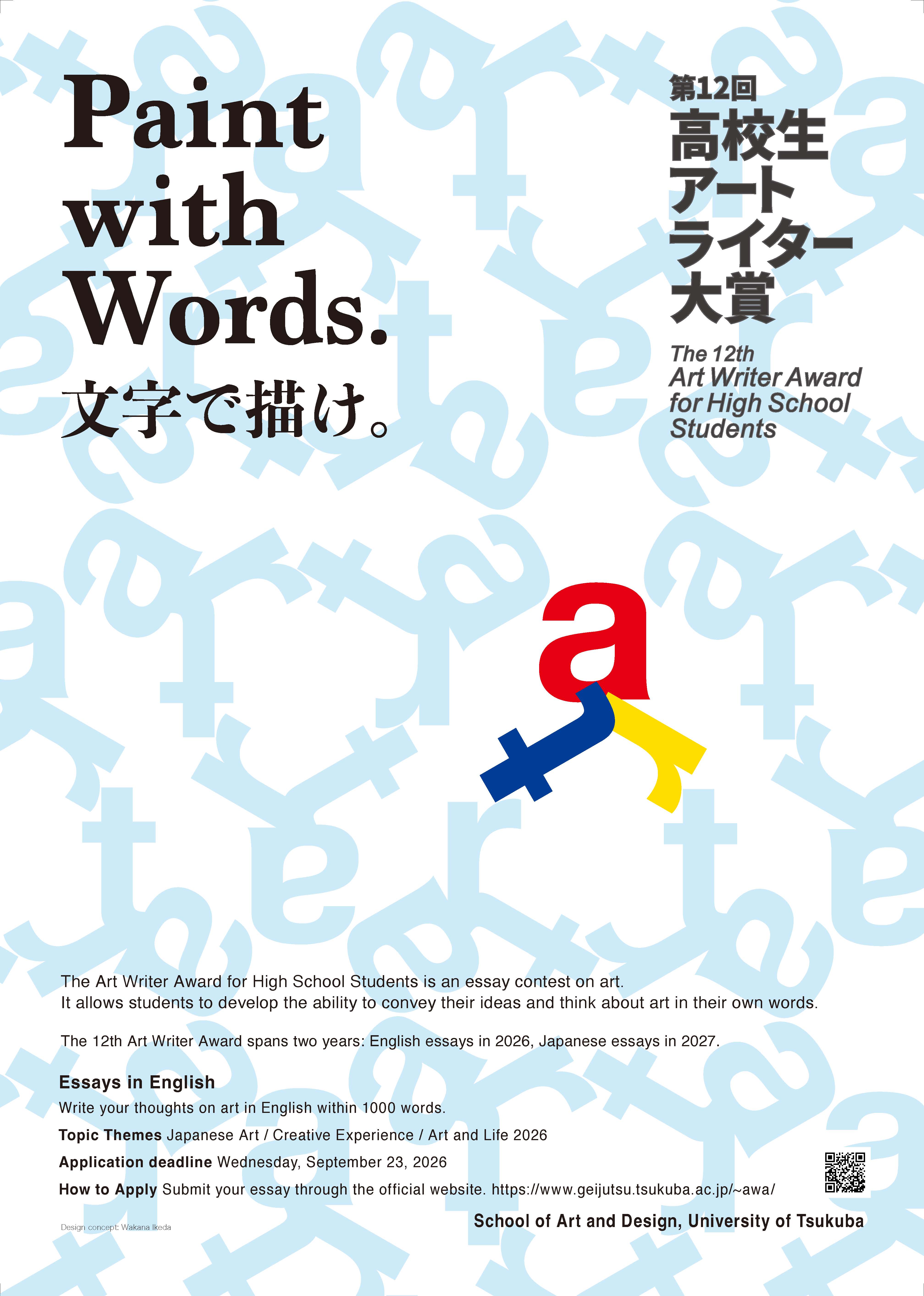
Applicants must be high school students or students attending a public institution equivalent to an upper secondary school (in Japan, mostly ages ranging from 15 to 18 years old) at the time of the application.
The essay must be written by the individual within 1,000 words in English.
Please give each essay a title.
You may think and write logically about the topic like a short thesis.
You may talk about your personal feelings as you might when reminiscing.
You may also focus on reporting a topic as would a journalist.
Although “Art” will be assumed to describe visual arts focused on art and design, the essay writer is free to define art according to his or her own view.
[1] Write your original essay
Find a theme, research it, record it, and think about it.
Write your thoughts on art in English in no more than 1,000 words.
Please review what you have written and seek advice from friends and teachers to improve it.
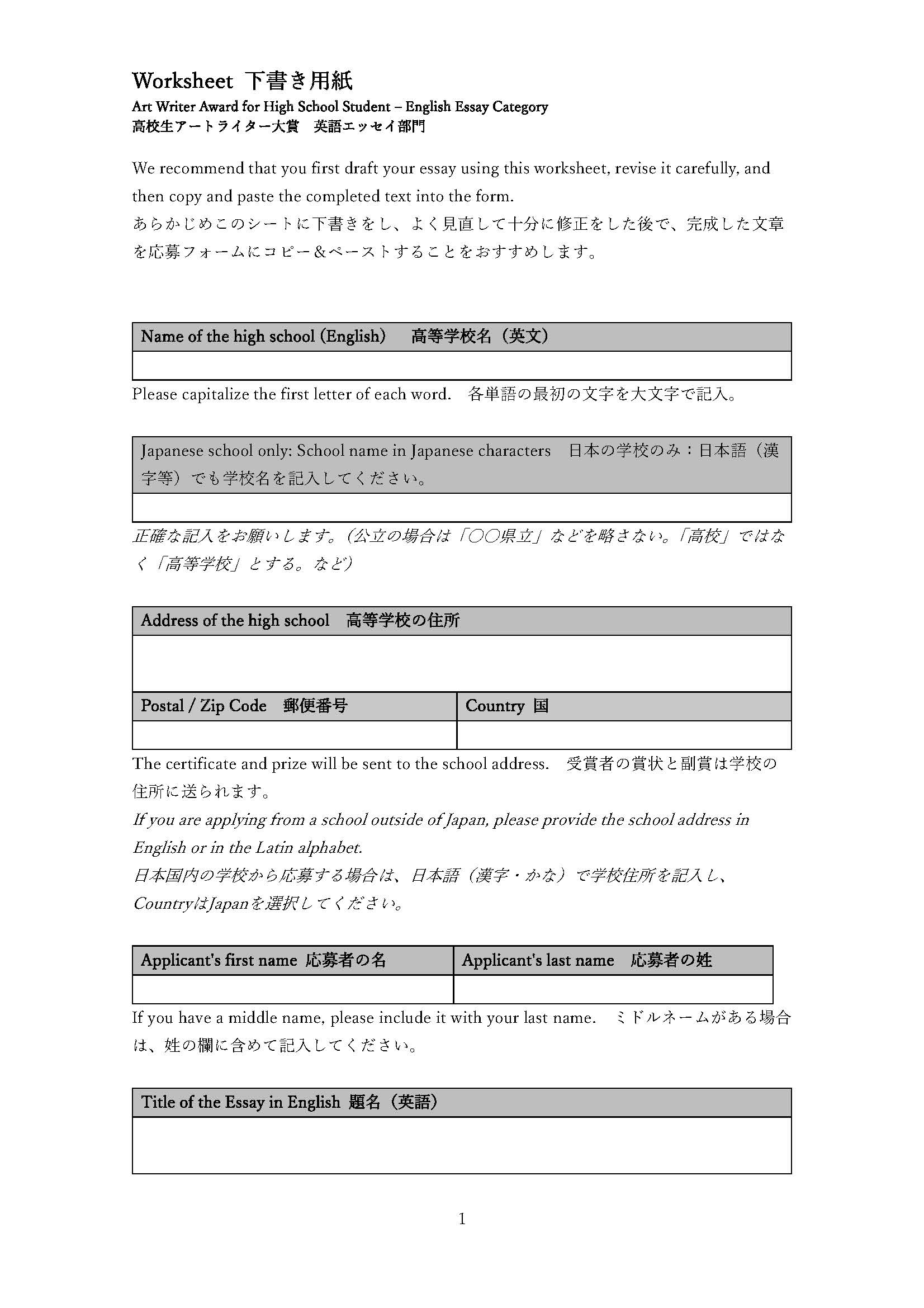
We recommend completing your essay using the Worksheet downloadable from the “Application Guide” page before pasting it into the application form.
[2] Start Your Submission
Once you have completed your essay, open the “Application Guide” page of our website.
Read the instructions carefully and click “Open the Application Form” at the bottom of this page.
[3] Fill in the applicant information
You can save your answers anytime by clicking the "Save" button at the bottom right of the page.
[4] Fill in the title and main text of your essay.
Complete your essay using the Worksheet and paste it into the application form.
Subheadings should be placed in [ ] to distinguish them from sentences.
Notes on Quotes
If you quote the thoughts or words of another person, use double quotation marks around the text (“ ”) and clarify within the body of the essay who the author is.
Example (Author’s surname publication year, quoted pages).
McClellan stated, “Art museums have never been more popular” (McClellan 2008, 1).
[5] Upload image files you want to include in your essay.
Up to 5 images can be uploaded.
Give the image a file name from Figure 1 through Figure 5.
Write a caption for the uploaded Figures.
The caption includes the title of the figure, its descriptions and its source (i.e., where the image was obtained).
Example 1: Caption for an artwork by another artist taken from a website.
(Artist’s name, Title of the Work, size, materials and techniques, year of creation. Name of the
website, URL)
Figure 1. Katsushika Hokusai, Under the Wave off Kanagawa from the series Thirty-six Views of
Mount Fuji, 25.7 x 37.9 cm, Woodblock print; ink and color on paper, ca. 1830–32.
Metropolitan Museum of Art, https://www.metmuseum.org/art/collection/search/45434
Example 2: Caption for an artwork by another artist taken from a book.
(Artist’s name, Title of the Work, size, materials and techniques, year of creation. Book author’s
surname, first name. Publication year. Book Title, publisher, page numbers.)
Figure 2. Yayoi Kusama, Narcissus Garden, Stainless steel spheres, an installation in the Valley
Gallery in Naoshima, 1966/2022. Ando, Tadao. 2022. TADAO ANDO 5 Dialogues, TOTO Publishing,
369.
Example 3: Caption for your own artwork
(Artist’s name, Title of the Work, size, materials and techniques, year of creation. The photographer’s
name, etc.)
Figure 3. Alex Ashton, Untitled, 45cm x 35 cm, watercolor on paper, 2026. Photo by the author.
[6] List of references:
Please list the sources of any quoted or referenced texts (books, websites, etc.).
Example 1: From a book
(Author's surname, first name. Publication year. Book Title. Publisher, page numbers.)
McClellan, Andrew. 2008. The Art Museum from Bullée to Bilbao. University of California Press, 25.
Example 2: From a journal article
(Author's surname, first name. Publication year. “Article Title.” Journal Title, volume number: page
numbers.)
Ashton, Alex. 2016. “Drawing on Philosophy – An Investigation of Theory in Praxis.” International
Journal of Education Through Art, 12: 271-272.
Example 3: From a website
(Author's name. “Article Title.” Name of the website, URL)
School of Art and Design.“History of the School of Art and Design”
Art & Design University of Tsukuba, https://www.geijutsu.tsukuba.ac.jp.
[7] Questions
Please answer the questions to improve our contest.
[8] Submission
After entering all the required information, click the “Save” button.
Review your entries for accuracy, and then click the “Submit” button.
All entered data will be displayed on the confirmation page.
You can print or save the information for your records.
You will receive a confirmation email once your submission is complete.
This email serves as official confirmation of your participation in the contest.
Personal Information
Information submitted through the online application form is encrypted and securely protected.
Personal information provided by applicants will be strictly managed and used only for the operation of this contest and for related research purposes.
Copyright
Copyright of submitted works remains with the applicants.
However, applicants grant the organizer, the School of Art and Design, University of Tsukuba, a nonexclusive, royalty-free license to use the submitted works for purposes related to the promotion, documentation, and publication of this contest (including reproduction, public dissemination, and publication).
In addition, when submitted works are made public, images such as photographs may be omitted due to copyright and related considerations.
|
応募案内
応募条件
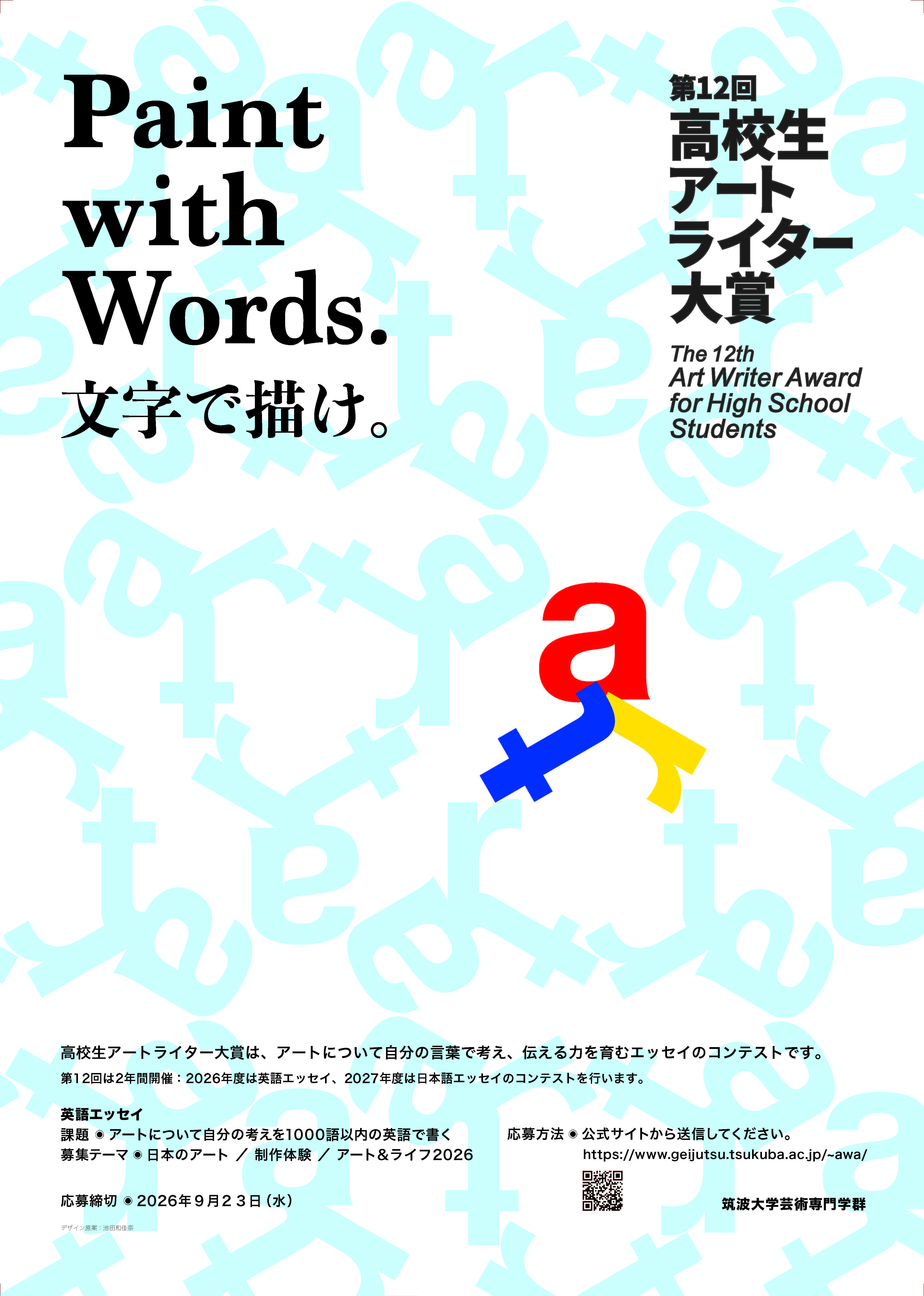
・応募者は応募時に、高等学校ならびにそれに相当する公的教育機関に在籍する生徒(日本では主に15歳から18歳)。
・題名を各自でつけてください。
・小論文のように論題を設定して論理的に考察しても、体験報告や随想のように個人的な思いを中心に語っても、雑誌や新聞記事のように伝えることを主眼にしたものでも構いません。
・「 アート」の範囲は、美術やデザインを中心とした視覚芸術を想定していますが、執筆者が自由に判断してください。
[1]あなた独自のエッセイを書く
テーマを決め、それについて調べ、記録し、そしてよく考えましょう。
1000語以内の英語で、芸術に対するあなたの考えを書いてください。
書けたら自分でよく見直すとともに、友人や先生にもアドバイスを求め、よく推敲しましょう。
「応募案内」のページからダウンロードできる下書き用紙に執筆した後で、完成した文章を応募フォームにコピー&ペーストすることをおすすめします。
[2] 応募を開始
エッセイが完成したら、ウェブサイトの「応募案内」のページを開きます。
説明をよく読んで、同ページの最下部にある「応募フォームを開く」をクリックします。
[3] 応募者情報を入力
記入途中で一時保存したい場合は、フォームの右下にある「Save」ボタンでいつでも記録できます。
[4] エッセイの題名や本文を入力
下書き用紙にエッセイを書き上げてから、それをフォームに入力しましょう。
小見出しは、本文の文章と区別するために、[ ]で囲んでください。
引用について
他の人の言葉や考えを引用する場合はダブルクオーテーションマークで囲み、例えば下記のように本文中でその著者情報を示してください。
例(著者の姓 出版年, 引用ページ)
McClellan stated, “Art museums have never been more popular” (McClellan 2008, 1).
[5] 掲載したい画像ファイルをアップロード
画像ファイルは5点までアップロードできます。
ファイルには、「Figure 1」から「Figure 5」までのファイル名をつけてください。
アップロードしたFigure(図版)のキャプション(情報)を記入してください。
キャプションには、図版のタイトル、説明、出典(どこから引用したか)が含まれます。
例1 ウェブサイトから引用した他の芸術家の作品
(作者名, 題名を斜体で, サイズ, 材料や技法, 制作年. ウェブサイトの名称, URL)
Figure 1. Katsushika Hokusai, Under the Wave off Kanagawa from the series Thirty-six Views of
Mount Fuji, 25.7 x 37.9 cm, Woodblock print; ink and color on paper, ca. 1830–32.
Metropolitan Museum of Art, https://www.metmuseum.org/art/collection/search/45434
例2 書籍から引用した他の芸術家の作品
(作者名, 題名を斜体で, サイズ, 材料や技法, 制作年. 書籍の著者姓, 名. 書籍出版年. 書籍名を斜体で, 出版社, 引
用ページ.)
Figure 2. Yayoi Kusama, Narcissus Garden, Stainless steel spheres, an installation in the Valley Gallery in
Naoshima, 1966/2022. Ando, Tadao. 2022. TADAO ANDO 5 Dialogues, TOTO Publishing, 369.
例3 あなた自身の作品
(作者名, 作品名, サイズ, 材料や技法, 制作年. 撮影者情報.)
Figure 3. Alex Ashton, Untitled, 45cm x 35 cm, watercolor on paper, 2026. Photo by the author.
[6] List of references(文献一覧)
引用した資料や参考にした資料(書籍やウェブサイトなど)の一覧を入力してください。
例1:書籍からの引用
(著者の姓, 名. 刊行年. 書名を斜体で. 出版社名, 引用ページ)
McClellan, Andrew. 2008. The Art Museum from Bullée to Bilbao. University of California Press, 25.
例2:雑誌からの引用
(著者の姓, 名. 刊行年. “論文や記事の題名.” 雑誌の名称を斜体で, 巻号: 引用ページ)
Ashton, Alex. 2016. “Drawing on Philosophy – An Investigation of Theory in Praxis.” International
Journal of Education Through Art, 12: 271-272.
例3:ウェブサイトからの引用
(著者名. “記事の題名.” WEBサイトの名称, URL)
School of Art and Design.“History of the School of Art and Design”
Art & Design University of Tsukuba, https://www.geijutsu.tsukuba.ac.jp.
[7] 質問
コンテストを改善するための質問項目がありますので回答してください。
[8] 提出
すべての記入が完了したら、「Save」ボタンを押して、記入内容に間違いがないか確認した上で、「Submit 送信」ボタンを押してください。
完了画面ですべての提出内容が表示されます。完了画面をプリント、保存することで提出の記録ができます。
提出完了の電子メールが届きます。そのメールは、コンテストへの参加証明書となります。
個人情報について
インターネットの応募フォームを通して送信された情報は暗号化され、安全に保護されます。
ご提出いただきました個人情報は厳重に管理し、本コンテストの運営および関連する研究の目的のみに使用します。
著作権について
応募作品の著作権は応募者に帰属します。
ただし、応募者は、主催者である筑波大学芸術専門学群に対し、本コンテストの広報、記録、出版等の目的のために、
応募作品を無償で使用(複製、公開、掲載等)する権利を許諾するものとします。
また、応募作品の公表に際しては、画像の著作権等の理由により、写真等を除いた形で掲載する場合があります。
|