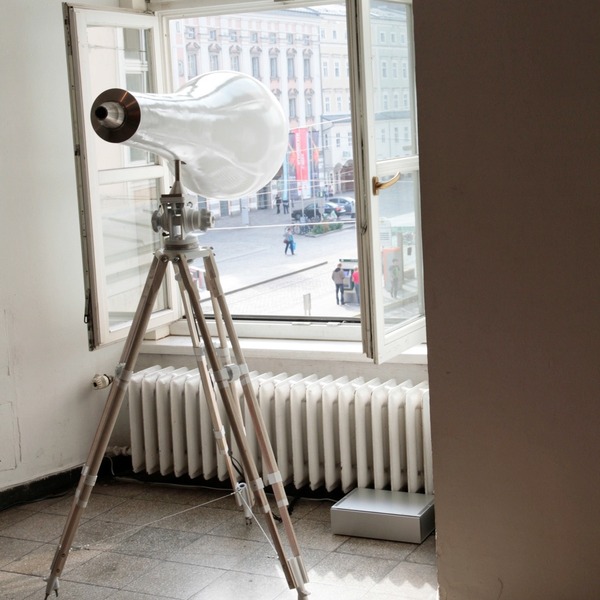
Tsukuba Scope is a video installation created for the Campus exhibition at the Ars Electronica Festival 2011. A single telescope is trained on the Hauptplatz, the main square of Linz. Peering into its eyepiece, the viewer watches objects that could not exist in reality begin to stir, and an unreal landscape takes shape. Inside the instrument, an ultra-high-definition monochrome display has been installed. To view an image through an eyepiece is to experience an immersion qualitatively unlike that of VR goggles. What is more, the viewer’s gaze is not confined within the enclosed space of the peep box; it extends continuously outward, toward the actual landscape beyond the lens. Comparing the image projected within the instrument against the real scenery spread out before them, the viewer draws an aesthetic experience from the difference between the two. Within the instrument, things that could never move in reality — the white lines of the road, the poles that bear posters — writhe as if they were living creatures. Before long the townscape is overrun by ivy, and the buildings, together with the Holy Trinity Column at the center of the square, recede into the ground itself. It is as though the viewer were present at a scene in which a townscape standing since the Middle Ages is dismantled and reconstructed by technology. The apparatus itself is built from an eyepiece section of solid stainless steel, a wooden tripod, and a barrel of white fiber-reinforced plastic. Rather than the ordinary cylindrical form, the barrel takes on a distinctive shape — as if the viewer’s gaze itself had been given extended, physical form.
Tsukuba Scope
Video installation,75×45×150cm
Ars Electronica Festival (Ars Electronica Linz GmbH & Co KG, Kunstuniversiteat Linz, Linz Austria)