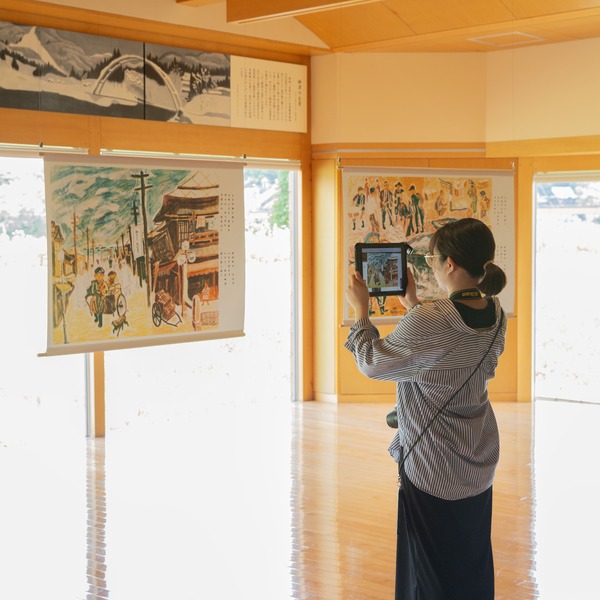
“The World of the Picture Books The Child of Sumiyaku and The Child of the North Sea” is a media exhibition project realized through a collaboration between the University of Tsukuba’s Taikan Taikan Lab, led by Fumiaki Murakami, and the Kiyoshi Saito Museum of Art, Yanaizu, which opened in the museum’s hall in September 2024. Through video production and related activities, the lab has long worked to promote the appeal of the museum and the town of Yanaizu and to revitalize the region. The exhibition is an attempt to bring back to life, by means of meticulous reproduction and AR technology, two picture books that Kiyoshi Saito—an internationally renowned printmaker with deep ties to Aizu—illustrated in his youth; a project underway since the previous year, it was unveiled in conjunction with the second phase of the exhibition “Reconsidering ‘Winter in Aizu.’”
The source materials are Sumiyaku Sato no Ko (1942) and Hokkai no Ko (1943): the former is set in a charcoal-making mountain village in Aizu, the latter in a fishing village near Otaru, and both depict local life through the eyes of the children who live there. The text was written by the children’s-literature author Daiji Kawasaki (1902–1980), and its rhythmic narration, rich in onomatopoeia, stands out. Because they were produced and distributed during wartime, the books contain scenes reflecting the circumstances of the era, and their paper and binding are plain; yet the front and back covers and all 11 double-page spreads are printed in full color. A warmth pervades the works as a whole—the earnest devotion of children helping with the family trade, and the tender gaze Saito directs toward them.
The original copies, however, having survived from the war years, have deteriorated badly, which made it difficult to display them over long periods or to show all of their scenes. Taking as its guiding principle the idea of “savoring a picture book as a picture book,” the project produced faithful replicas in which even the original colors and the texture of the paper were carefully recreated, and arranged a space where visitors could actually pick them up and read them. It further developed AR content whereby holding an iPad over banners displaying enlarged scenes causes the pictures to move, sounds to play, and commentary to become readable; through audio gathered by the students, scenes of charcoal-making and the fish market are brought vividly to life. The students completed the exhibition while staying in the town of Yanaizu, through repeated trial and error.
The distinctiveness of this work lies in the way it transforms the conflicting demands of preserving and exhibiting fragile archival material into an embodied viewing experience mediated by reproduction and augmented reality. It is also a practice of regional collaboration between a museum and a university, opening up in a new form both the value of these works as creations by Kiyoshi Saito and their documentary value in conveying the life of a bygone era. While feeling a sense of nostalgia at the depicted labor of the charcoal-making and fishing villages, visitors come to relive—through their own hands and bodies—Saito’s gaze, which links a way of life from more than 80 years ago with the present.