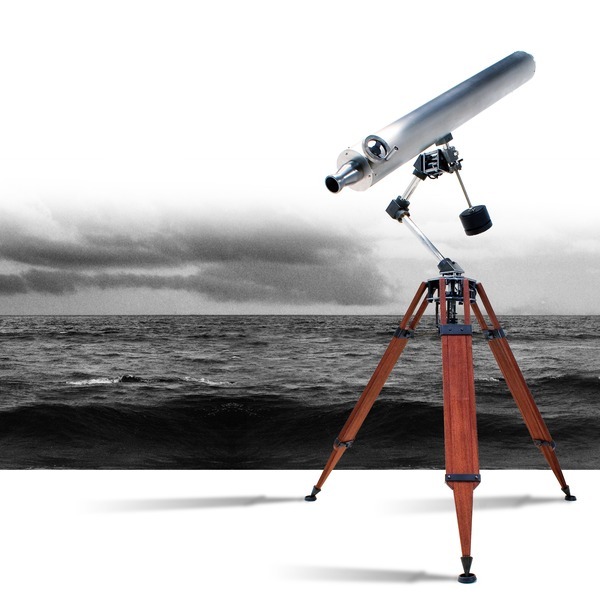
Spyglass is a video installation combining sculpture, moving image, and sensing technology. Peering through the eyepiece of a telescope-like apparatus, the viewer discovers a vast sea and horizon stretching out within.
Holding the eyepiece and rotating the barrel, the viewer can survey a fully spherical, 360-degree image; turning a handle mounted on the barrel zooms the image in and out at will. From the eyepiece to the barrel to the tripod, every part has been designed specifically for this work, so that operating it feels at once precise and weighty.
The mechanism resembles the virtual reality of a VR headset. Yet here the operation is heavy, demanding of the viewer a far greater physical effort. In place of the passive spectatorship invited by screen-based media, the viewer is drawn into active participation, and becomes newly aware of the presence of their own body. Telescopes and binoculars are instruments for drawing a distant reality—one beyond the reach of the naked eye—into our hands, and we accept the images they offer without question. This work takes that very trust in the optical instrument as its starting point. Gazing at the horizon, one watches as various objects rise up from far away, only to dissolve like a mirage. They appear with a certainty indistinguishable from the actual scene.
The horizon is the boundary between sea and sky—clearly visible to the naked eye, and yet a line that exists nowhere in physical space. However far one zooms in, it is a point that can never be reached. It is there to be seen, and yet nothing is there.
Spyglass was made to ask what it means to see the invisible.