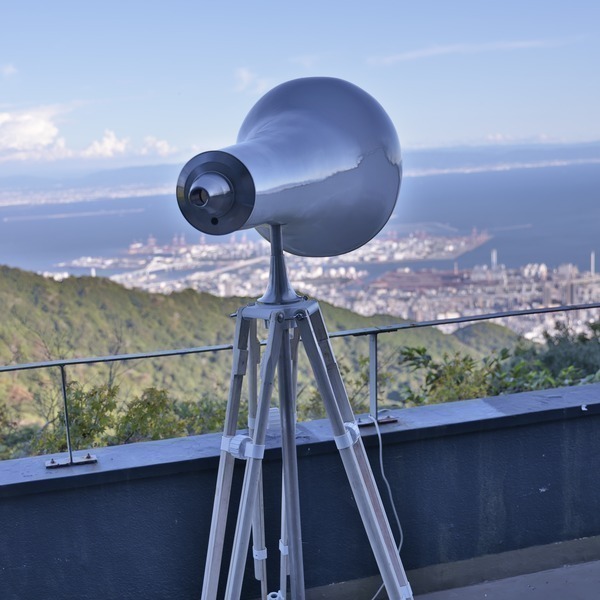
Phantasmagoria Machine of Mt. Rokko (六甲風景幻灯機) is a site-specific video installation combining sculptural form with moving image, belonging to the Landscape Magic Lantern series developed by the artist Fumiaki Murakami. In 2025 it was chosen for the open-call section of “Kobe Rokko Meets Art 2025 beyond” as one of 15 works selected from 389 entries, and was installed and exhibited at Rokkosan Silence Resort. Reaching its 16th edition this year, the festival is a public–private initiative for regional revitalization. The work employs a mode of viewing in which the spectator peers into the interior of the device through an eyepiece lens, as though looking through a telescope, comparing the actual landscape before their eyes with the image displayed inside. Set on the Rokko mountainside, it offers a view beyond the lens that sweeps from the urban center of Kobe to its harbor and the Seto Inland Sea. At first glance the interior image appears identical to the scene in front of the viewer, but in the next moment extraordinary scenes emerge—a colossal soft-serve ice cream cone, a giant head of broccoli, a white bird soaring across the sky, a child playing with stacking blocks. By deliberately defamiliarizing the commonplace landscape, the work directs a fresh gaze toward a nature submerged in everyday life, while at the same time interrogating the very structure of human perception as it oscillates between the real and the virtual. The theme of “the gaze directed at landscape” is rooted in the recognition that the more commonplace a natural scene is, the more readily its aesthetic qualities go unnoticed—as when Cézanne remarked of Mont Sainte-Victoire that the peasants did not look at the mountain. The artist himself was born in Kobe and grew up amid the nature of Rokko, yet became aware of its appeal only after moving away to another prefecture. The work further connects this defamiliarization of landscape to ecological thought. Invoking the ancient worldview found in the legends of the Rokko range’s sacred rocks (iwakura)—in which nonhuman entities such as animals, trees, and rocks are treated as equals to human beings—it questions the anthropocentric, modern framework that regards nature as an object of domination. This resonates with the problem Bruno Latour articulates: that such a framework has, in the present age, already become difficult to apply. Through the difference from the landscape before them, the viewer is led toward an ecological perspective that grasps nature as an existence of value equal to the human. In technical terms, the work is made from materials including FRP (fiber-reinforced plastic), stainless steel, a microcomputer, a high-definition LCD panel, optical lenses, and concrete; the body measures approximately 80 × 35 × 100 cm, weighs about 100 kg, and consumes 15 W (100 V, 0.15 A). Possessing a durability that requires no maintenance even through more than four months of continuous outdoor operation, it integrates advanced engineering and information technology with sculptural form to achieve a high level of aesthetic refinement as media art exhibited outdoors. It also contributes to the creation of tourism that serves regional revitalization; joining technology and form, the work opens up new possibilities for contemporary expression concerning ecology.
Phantasmagoria Machine of Mt. Rokko
Installation, projection video
Kobe Rokko Meets Art 2025 beyond / Rokko-san Silence Resort