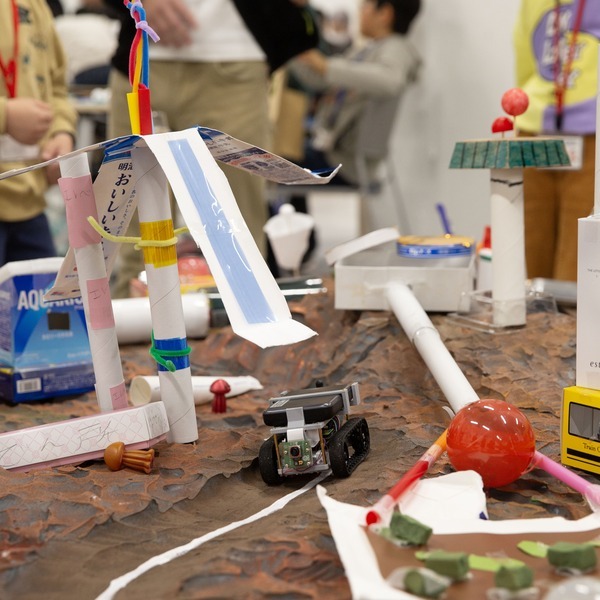
“Mars Terraforming Workshop—Let’s Build a Future Town on the Martian Surface” is a workshop held on February 22, 2026, at the Hitachi Civic Center Science Museum by the Hitachi Civic Center chapter of the Young Astronauts Club of Japan (YAC), with Fumiaki Murakami of the University of Tsukuba and his students serving as instructors. It was aimed at members of the Young Astronauts Club, centered on students from the third year of elementary school through the third year of junior high school; on the day, a total of 63 people took part, including 28 club members. Its purpose was to fuse scientific knowledge with artistic imagination—designing bases and cities for living on Mars out of cardboard and waste materials—and thereby to broaden interest in space while cultivating awareness of environmental concerns and the reuse of resources (the SDGs).
The workshop employs the narrative framework of “a Mars survey team that has come from the future.” Under the premise that, on a future Earth grown polluted, migration to other planets has been planned, the participants are entrusted with the mission of turning Mars into “a planet one would want to live on.” The activity is structured as a series of “missions.” First, the children learn about the Martian environment, encountering such features as its red terrain, gravity one-third that of Earth, an average temperature of about −60°C, and subsurface ice, along with a comparison to Venus and the question of how to use finite resources sustainably. In the strategy meetings that follow, they discuss in groups the advantages and likely difficulties of living on Mars and what would be needed to make it a planet worth living on, expressing their ideas in words and illustrations. Bringing these ideas together, they combine waste materials—such as snack boxes and the cardboard tubes from plastic-wrap rolls—with colored construction paper, colored cellophane, and aluminum foil to build dome-shaped habitats, plant domes, power-generation facilities, exploration rovers, and the like, arranging them on a large reddish-brown panel representing “the Martian surface” at the center of the venue, so that all the participants together complete a single Mars base (colony). Once finished, they gather around the works to present the features they devised and their reasons, and finally they reflect on living on Mars and on Earth, recording their thoughts on a worksheet.
The completed work is exhibited at the science museum and is also scheduled to be shown at the “Hitachi Children’s Art Festival” held on March 7. The students took the lead in running the event on the day, and safety was taken into account wherever box cutters and glue guns were involved. As suggested by the children’s impressions, such as “I realized what an amazing planet Earth is,” the workshop is designed so that, through the act of envisioning the extraordinary world of Mars, it conversely prompts an awareness of the environment and the way of life on Earth. This educational aim is crystallized in the survey team’s closing words to the participants: that they should make the Earth they live on now, too, an attractive and livable place.