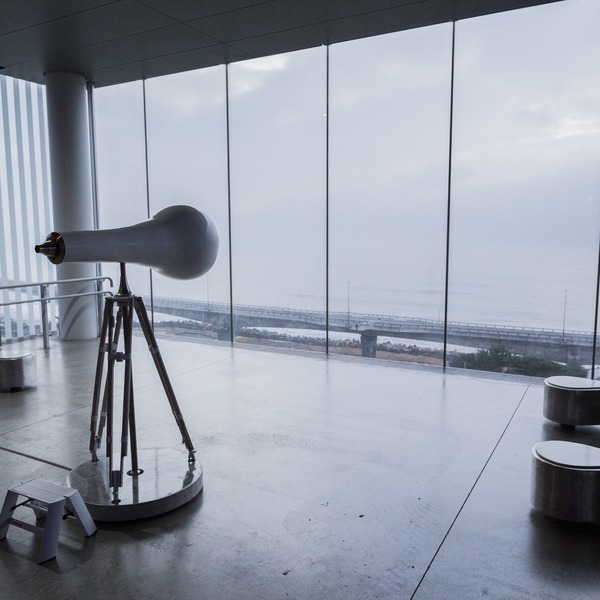
This work is an installation comprising telescope-shaped video devices, which the author has installed at two sites in Ibaraki Prefecture: the former Miwa Junior High School in Hitachiōmiya City and Hitachi Station in the city of Hitachi. When the viewer looks into the eyepiece, a seascape of Hitachi spreads across the field of view. As the gaze is sustained, however, events that could not occur in reality begin to emerge within the landscape. The imagery derives from the Hitachi no kuni fudoki, a provincial gazetteer compiled in the first half of the eighth century following an edict of the imperial court issued in 713 (Wadō 6). The work takes as its subject the legend of the “high peak of Kabire” (Kabire no takamine), recorded in the section on Kuji District—an area corresponding to the present-day northern region of the prefecture—and reconstructs the mythic events described in the text as moving images embedded within actual landscapes. The Hitachi no kuni fudoki is one of the few ancient fudoki still extant, and it constitutes a foundational document transmitting the region’s ancient local traditions to the present day. The telescope is an optical instrument that magnifies and presents distant objects “as they are,” and the images it affords are generally received as possessing a high degree of reality. Taking this perceptual trust in the apparatus as its premise, the work deliberately blurs the boundary between the real and the fictive by gradually introducing fantastical imagery into footage grounded in actual scenery. Through this experience, the viewer comes to sense that the events recorded in the ancient text might indeed have taken place in this very land. The work may thus be understood as an attempt to reactivate the mythic memory latent in the region as an embodied, perceptual experience by superimposing textual tradition upon the perception of the present-day landscape. That both installation sites lie within the northern region of the prefecture, where the tradition itself has been handed down, constitutes the site-specific condition that sustains the correspondence between the projected imagery and the actual place.
Landscape Magic Lantern (Hitachi)
Materials: FRP, SUS304, A2017, wooden tripod, concrete, IPS LCD, microprocessor, quartz glass, switching power supply unit, robot cable Dimensions: 1400 x 750 x 1550 mm + ocean (scenery), looped video
JR Hitachi Station