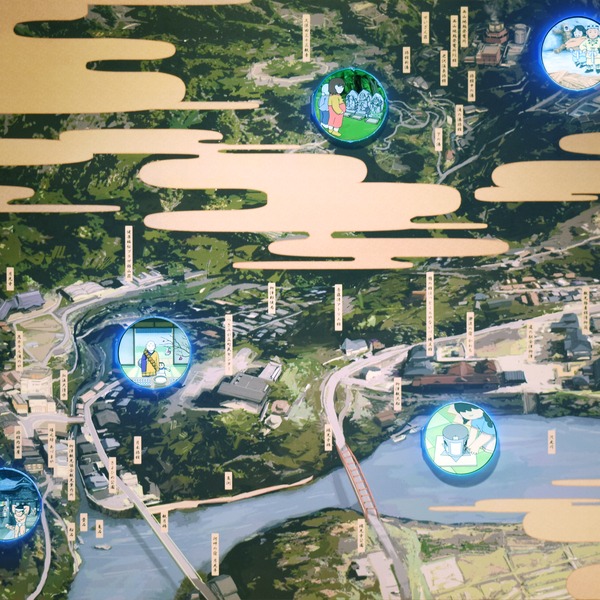
Kisei Yanaizu Chōkanzu (A Bird’s-Eye View of Yanaizu, in Prayer for Fair Weather) Kisei Yanaizu Chōkanzu is a mixed-media work that combines a large-format illustration of the entire town of Yanaizu, seen from above, with five circular monitors. The town’s terrain—cradled in the mountains along the Tadami River—is rendered as a single bird’s-eye view, together with its houses and its temples and shrines, foremost among them Enzō-ji, the temple of the bodhisattva Fukuman Kokūzō. Like round windows opened here and there across this panorama, the five monitors offer glimpses of animations of the festivals and annual rites handed down in the town. The still aerial view and the images that stir quietly within it resonate with one another, so that the perspective gazing down on the town from the sky and the perspective entering into the very midst of people’s daily lives come to overlap within a single frame. The monitors show such observances as the Nanokadō Hadaka Mairi (a midwinter rite in which loincloth-clad men climb a rope toward a great temple gong), Dango-sashi (the skewering of rice-flour dumplings onto tree branches), Sai-no-kami (a New Year bonfire rite), and Sendomushi—events carried on without a break in Yanaizu. Yet what the work portrays is not the dazzling climax of the festivals themselves. Its gaze rests instead on people quietly making ready for the festival day: men twisting rope on snowy nights, households skewering dumplings, straw being bound to raise the Sai-no-kami. The intention is to bring into view the steady, unshowy labor—and the bonds between people—that have sustained these rites, kept alive year after year by neighbors helping one another, in a life lived alongside the gods and buddhas. “Kisei” means, literally, “to pray for clear skies.” In the deep snows of Oku-Aizu, the wish for fair weather carries a particular weight. The title holds two prayers at once: the townspeople’s longing for the hare days—the days of festival they await—and the makers’ own wish that the irreplaceable life of Yanaizu might go on, cloudless, in the years to come. The work was made by students of the University of Tsukuba for the 2021 Yanaizu no Kahō-ten (Treasures of Yanaizu) exhibition, whose theme was festivals and annual observances. With the COVID-19 pandemic forcing their visits to Yanaizu to be postponed or canceled again and again, the students built up their picture of the town from materials gathered by the Kiyoshi Saito Museum’s community-revitalization team and from interviews conducted remotely, and so saw the piece through to completion. Gathering up the treasures of Yanaizu through the eyes of outsiders—visitors from elsewhere—the work gives visible form to a life lived close to the gods and buddhas, and to the prayers and fellowship that sustain it. In this it quietly echoes the very subject Kiyoshi Saito devoted his career to carving into his prints—the earnest lives of the people of the snow country—even as it seeks to carry the memory of this depopulating town to audiences both within it and beyond.
Kisei Yanaizu Chōkanzu (A Bird's-Eye View of Yanaizu, in Prayer for Fair Weather)
Mixed media
Kiyoshi Saito Museum of Art