[Award] A first-year student from the School of Arts and Design won both the Minister of Education, Culture, Sports, Science and Technology Award (Grand Prize) and the Council Award at the 7th Medical Innovation Idea Contest.
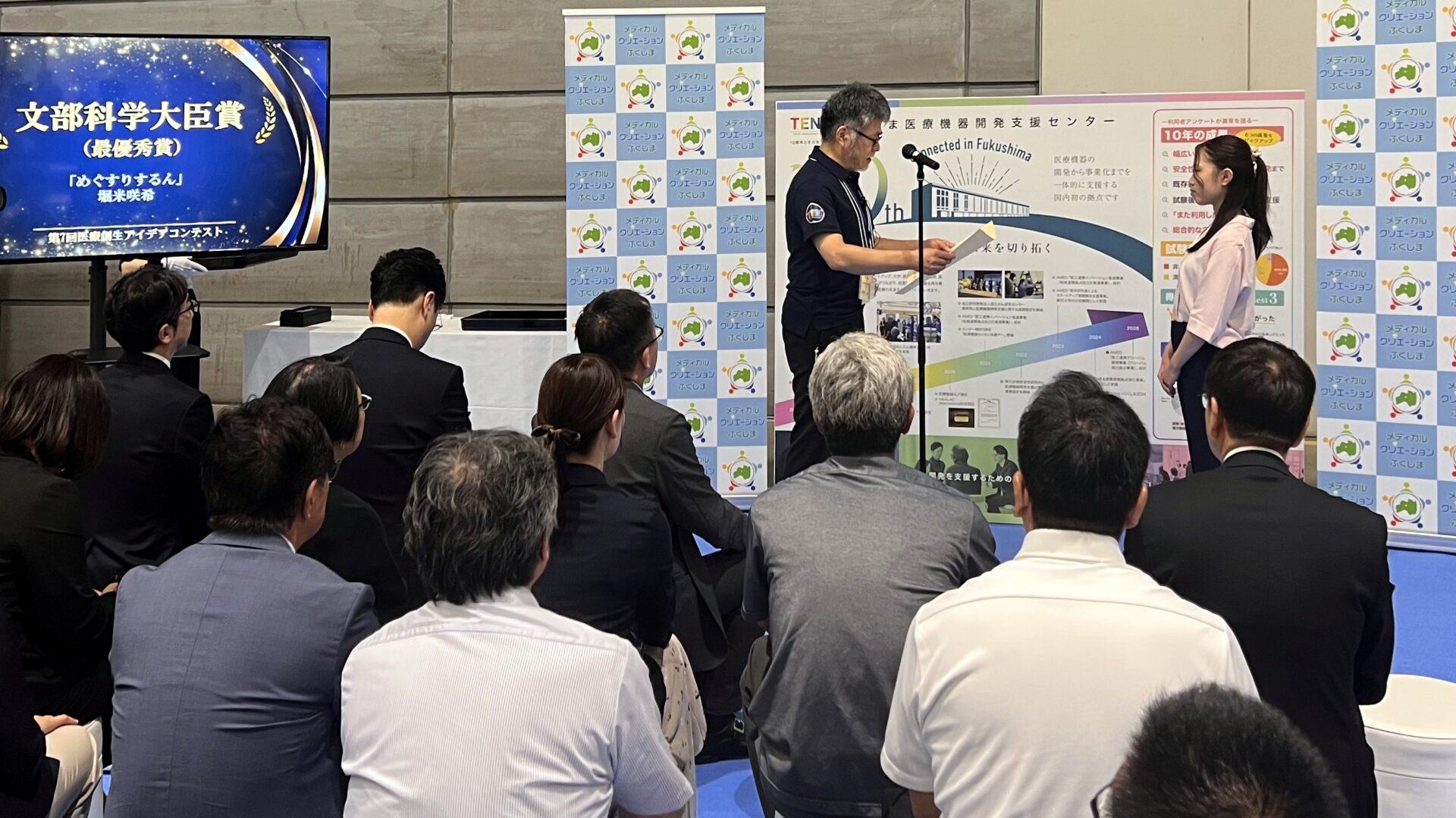
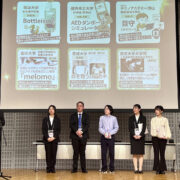
The award ceremony for the Minister of Education, Culture, Sports, Science and Technology Award. Ms. Horikome is on the right. The name of the award and the name of the winning work, "Megusuri Surun," are displayed on the screen on the left.
On Friday, October 2, 2026, the final judging of the "7th Medical Innovation Idea Contest" (organized by the Fukushima Medical Device Development Support Center) was held at Big Palette Fukushima in Koriyama City, Fukushima Prefecture. Saki Horigome, a first-year student in the School of Art and Design at the University of Tsukuba, won both the Minister of Education, Culture, Sports, Science and Technology Award (the highest award) and the Special Award (Council Award) for her product "Megusuri Surun".
This contest, open to high school students to graduate students, received 205 ideas from across the country. Six teams that passed the initial screening then presented their final ideas at "Medical Creation Fukushima 2026," a trade show for the medical device industry.
An eye drop aid for children, designed based on family experience.
The theme for this episode is "How would you solve the 'problems' in healthcare and nursing care in this town?". The first thing that came to Ms. Horikome's mind was her family. In her hometown of Sendai, her whole family suffers from hay fever, and her younger sister, when she was in kindergarten, used to cry every time because she was afraid of eye drops.
When I asked my younger sister why she was scared, she gave me three answers: she couldn't do it properly, she didn't know when it would fall, and she was scared because she could see the tip of the eyedropper. "Megusuri Surun" is a prototype of an eyedropper that aims to alleviate each of these three anxieties. It is intended for use by children from kindergarten to early elementary school, and it works by having them look through a kaleidoscope and then squeeze a lever to apply the eyedrops themselves. Different colored parts address each of the three anxieties.
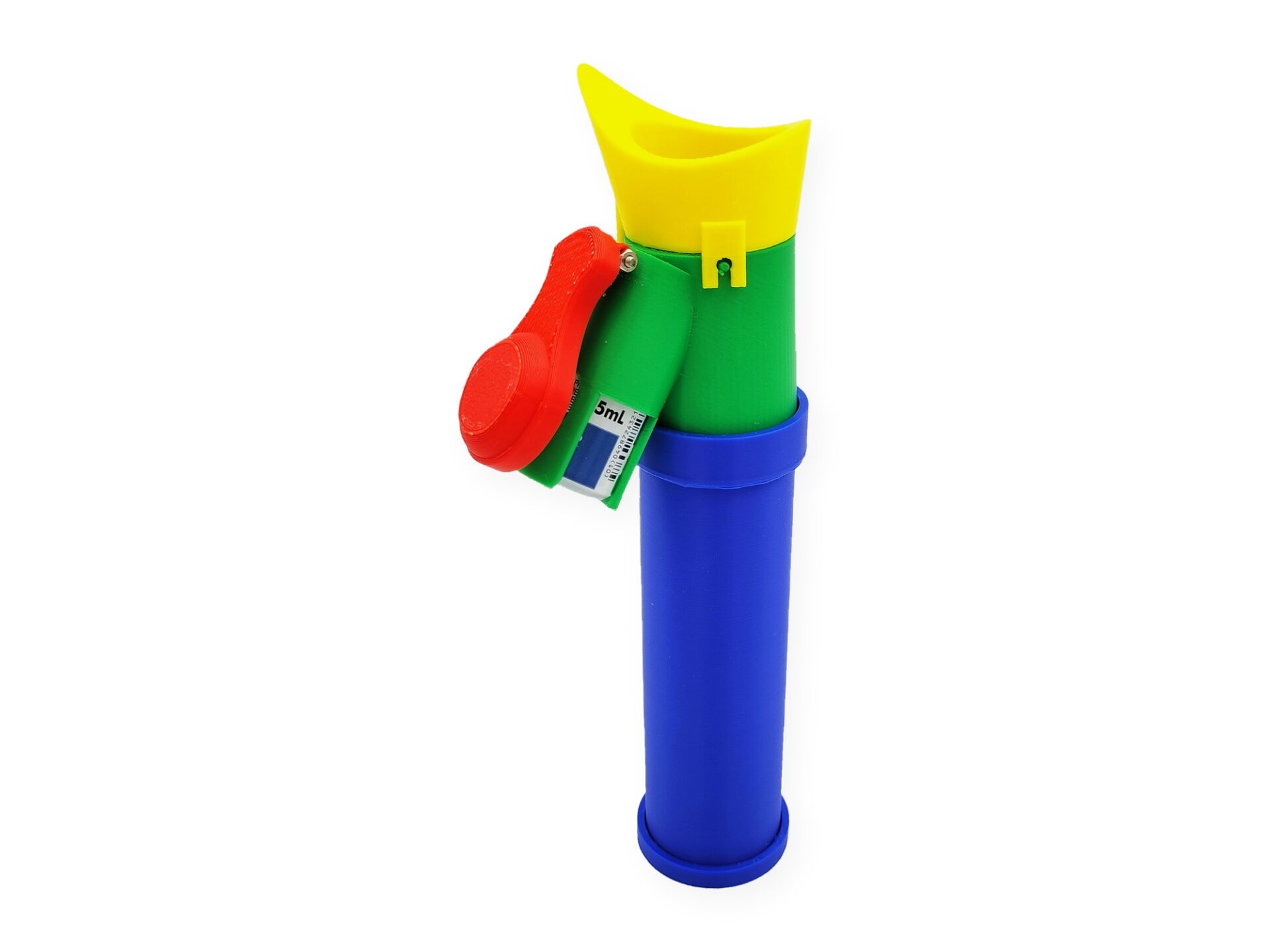
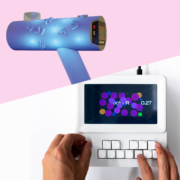
A prototype of "Megusuri Surun" made with a 3D printer. The yellow part is the part that goes around the eyes, the red is the lever for applying eye drops, the green is the part that changes the direction of the tip of the eye drop bottle, and the blue is the tube of the kaleidoscope.
- If you can't do it properly → Use the yellow part that fits the shape of the eye area, and support the tube by placing it against the face.
- You don't know when it will fall → The child themselves will hold the red lever and decide when to insert it.
- The visible tip is scary → Use the green part to move the tip of the eye drop bottle away from the center of your line of sight (a technique based on expert advice from August, suggesting that dropping it towards the white of the eye reduces the fear and irritation).
The yellow part can be removed and wiped clean, and by changing its orientation, it can be used for either the left or right eye.
A kaleidoscope that lights up when you point it straight up.
During the production process, Horigome noticed two problems. First, with the initial bead-type kaleidoscope, the beads would settle at the bottom and the pattern would stop if it was pointed straight up. Second, it was difficult to tell if you were pointing straight up or not while looking through it.
Taking advantage of these two things is a kaleidoscope that incorporates a tilt sensor and a full-color LED. In a normal kaleidoscope, the pattern changes when you move it, but with "Megusuri Surun," the pattern moves when it stops at the correct angle. It doesn't light up when it's horizontal, but it starts to light up as you raise your face, and shines brightest when it's directly above you. The light serves as a clue to know when you're looking straight up, and also as a signal to apply eye drops.
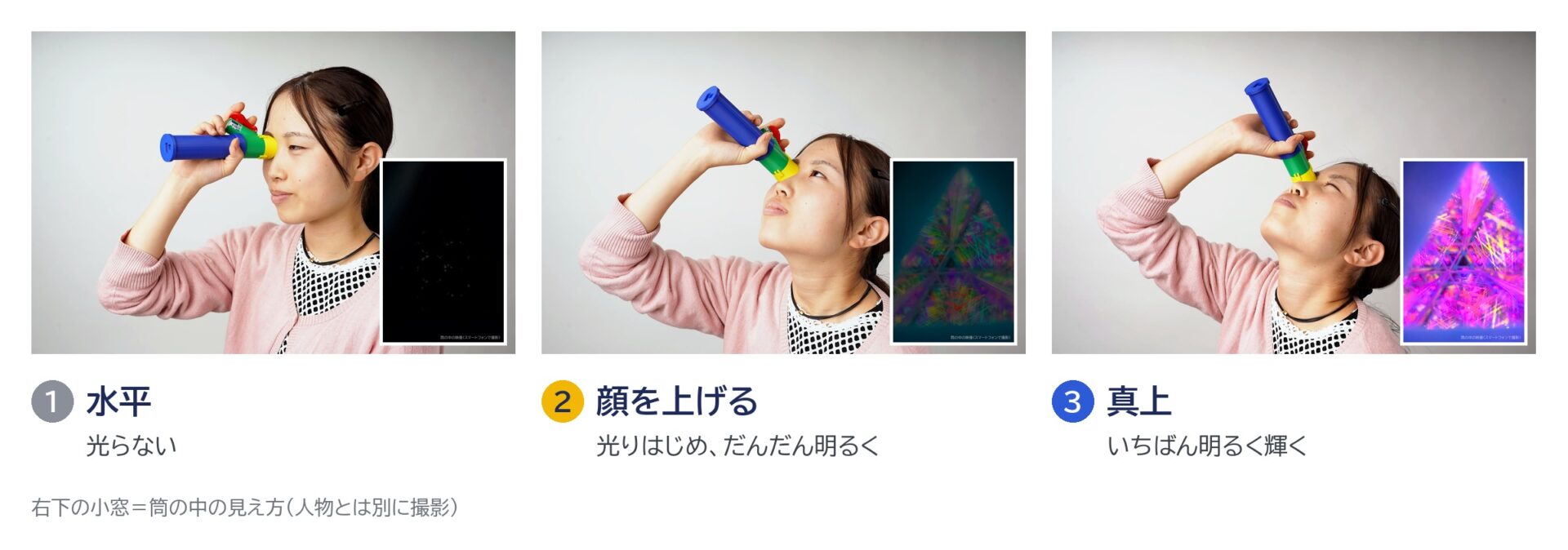
The brightness of the kaleidoscope changes depending on the tilt of the tube.
The kaleidoscope mirrors can be swapped out using six different cartridges. By scraping the paint on the back of the mirror to draw lines, light will shine through, allowing you to create your own unique patterns. Creating patterns together as a family is one way to turn eye drop time into something enjoyable.
The intended use is for parents and children to initially hold the lever together, and then for the child to use it independently once they are comfortable. Our goal is for this to be a tool that remains as a kaleidoscope and a cherished memory of the parent-child relationship even after the child no longer needs the aid.
From paper models to working prototypes
Ms. Horigome entered this contest as part of an assignment for the "Basic Design Workshop 1" course (taught by Associate Professor Toshiro Uchiyama) in the School of Art and Design. When she submitted her entry in June, her prototype was a paper model. After passing the first round of judging, she spent much of her summer vacation at the university, receiving individual guidance from Associate Professor Uchiyama, designing parts using 3D CAD for the first time, and repeatedly creating prototypes with a 3D printer. At the final judging session, she presented her work with a prototype that actually lit up.
The head of the judging panel praised the project for progressing from paper models to 3D-printed prototypes, and also expressed interest in the ingenuity of allowing users to create their own patterns.
Students under my guidance receive double awards for the third consecutive year.
The first time a student supervised by Associate Professor Uchiyama entered this contest was in 2024, during the 5th edition. Nozomi Inagaki, a first-year student in the Graduate School of Design Studies (Master's Program), won both the Excellence Award and the Council Award with her first entry.
In the 6th competition held the following year, 2025, Mio Segami, a first-year student in the Department of Arts and Design, also won both the Excellence Award and the Council Award. And this time, Ms. Horigome received both the Minister of Education, Culture, Sports, Science and Technology Award and the Council Award, marking the third consecutive year that a student under her supervision has received both awards.
- 5th Annual Award (2024) Nozomi Inagaki (Graduate School, Design Studies Degree Program, 1st Year Master's Student) - Excellence Award and Special Award (Council Award)记事)
- 6th Annual (2025) Mio Segami (1st year, School of Arts and Design) - Excellence Award and Special Award (Council Award)记事)
- 7th Annual Award (2026): Saki Horigome (1st year student, School of Arts and Sciences) - Minister of Education, Culture, Sports, Science and Technology Award (Grand Prize) and Special Award (Council Award)
*Affiliation and grade level are as of the time of the award.
Following in the footsteps of Ms. Segami last year, another first-year student this year has achieved success in a national contest thanks to their coursework.
Contest overview
- Name: The 7th Medical Innovation Idea Contest
- Organized by: Fukushima Medical Device Development Support Center
- Final judging session: Friday, October 2, 2026
- Venue: Big Palette Fukushima (Koriyama City, Fukushima Prefecture - within the Medical Creation Fukushima 2026 venue)
- Theme: How would you solve the "problems" in healthcare and nursing care in this town?
- Applications: 205 (6 groups advanced to the final round)
- Sponsored by: Ministry of Education, Culture, Sports, Science and Technology, Ministry of Health, Labour and Welfare, Ministry of Economy, Trade and Industry, Fukushima Prefectural Board of Education, Fukushima Minpo, Fukushima Minyu Shimbun
- Official page:https://fmddsc.jp/event/event-idea-contest7/
Award results for the day
The following is based on the announcement made at the awards ceremony on October 2, 2026. The names listed are entry names (school names), with titles omitted.
- Minister of Education, Culture, Sports, Science and Technology Award (Grand Prize): Saki Horigome (University of Tsukuba) "Megusuri Surun"
- Excellence Award: Ibuki Morinaga (Nihon University Third High School) "Day Break - A spirit that can continue tomorrow. -"
- Excellence Award: CST (International College of Information Technology and Automotive Engineering) "Smart Shoes 'Okaeri'"
- Excellence Award: PicLab☆ (Saitama City Omiya International Secondary School) "PicMed"
- Special Award (Council Award): PicTlab☆ "PicMed", Saki Horigome "Megusuri Surun" (2 awards this time)
- Winner: Mamidori (Kokushikan University) "PreAid"
- Award Winner: Tetsumon Toseikai (University of Tokyo) "Straight Spoon"