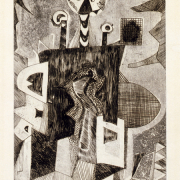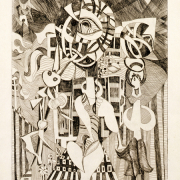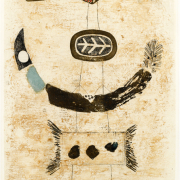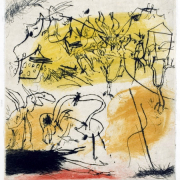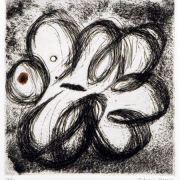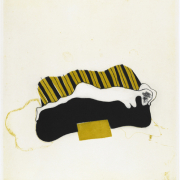
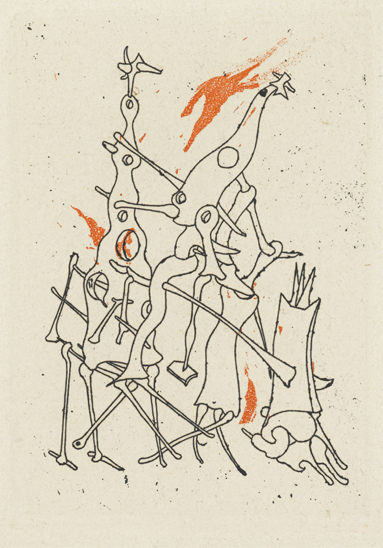
Yves Tanguy “Midnight of the Giants”
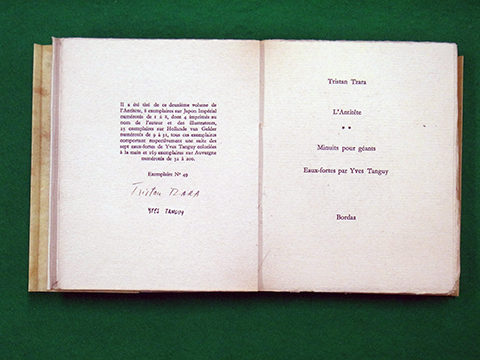
Author birth and death: 1900 Paris (France) – 1955 Woodbury (USA)
Technique Material: Etching
Dimensions: 14.0 x 11.0 cm (sheet); 9.5 x 6.7 cm (plate mark)
Exhibition history: "Manabia Terrace Opening Commemoration: University of Tsukuba Ishii Collection Exhibition: Encountering Beauty: [First Half] Encountering the World of Paintings", Manabia Terrace [Higashine City Art Museum], November 2016rd - December 11th, 3 , cat. 12c.
literature:YVES TANGUY. DAS druckgraphische Werk [exhibition catalog], Wolfgang Wittrock Kunsthandel, Dusseldorf, April – May, 1976, nos.17A-17G; Edited by Rintaro Terakado, “Ishii Collection I. Paintings from the University of Tsukuba,” University of Tsukuba, Faculty of Art, 2011, cat. 2 -b; Edited by Rintaro Terakado, "Ishii Collection Research 7: Tristan Tzara's 'Anti-Brain'", University of Tsukuba College of Art, 2020, col. ills. pp. 12-13; Fumi Tsukahara, "From DADA to AA - Tzara's ``Hybrid exploration of locus and ``anti-brain'''', ``Ishii Collection Research 7: Tristan Tzara's ``anti-brain'''', 2020, pp. 17-35.
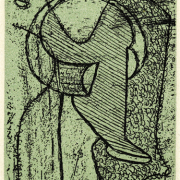
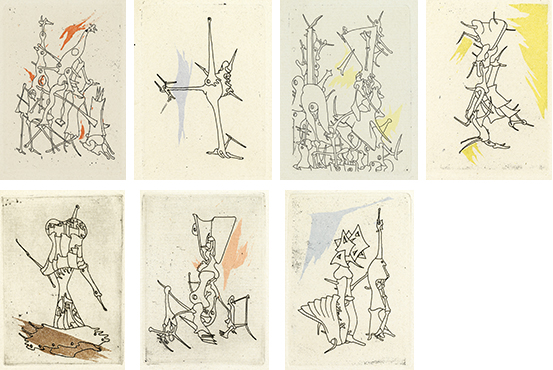
Notes: 7 points.Etching illustration for Tristan Tzara's Anti-Brain (1949, published by Bordas, Paris).
Tristan Tzara “Anti-Brain”
Author's birth and death: 1896 Moinesti (Romania) – 1963 Paris (France)
Year of production: 1949
Publisher: Bordas (Paris)
Notes: A collection of prose poems (23 volumes) with 3 etching illustrations by Max Ernst, Yves Tanguy, and Joan Miro.Number 200 out of a limited edition of 49 (numbered on each volume door).
Collection number: 2008-FP-IS002
Explanation:
In 1933, the poet Tzara published an anthology of his works published between 16 and 32 called Anti-Brain, with illustrations by Pablo Picasso.Sixteen years later, she published a new edition in three volumes, limited to 16 copies, with etchings by Max Ernst, Yves Tanguy and Joan Miro.``Mr. Anti-Philosopher Aa,'' which expresses Tzara as a Dadaist, ``Midnight of the Giants,'' which shows the transition period from Dada to Surrealism, and ``Desperante,'' which depicts the automatism of the Surrealists. Ernst, Tanguy, and Miró provided illustrations for each.In particular, Miro's illustrations use clear colors to paint the shapes of the moon and stars, and their bright and free imagination is free from the constraints of Tzara's text, so they are more like poets and painters in the true sense of the word. It could be a collaboration.