Tsushima Survey August 2022

I went to Tsushima to investigate.

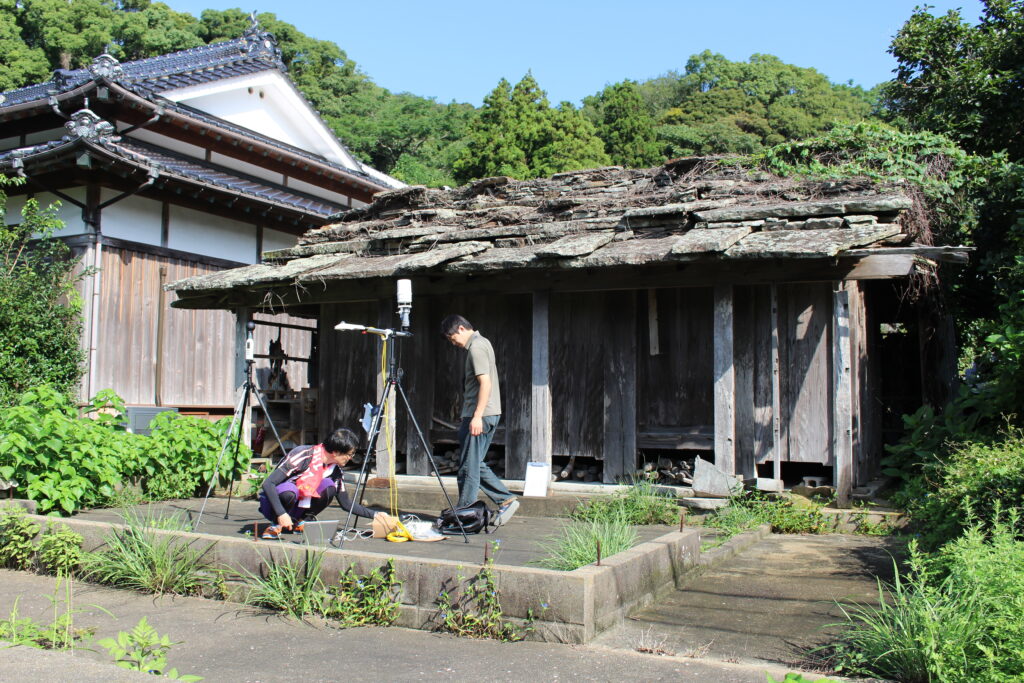
This time, it was a joint investigation with Meijo University's Ishii Laboratory for a preliminary survey of the thermal environment and a survey of the current status of Koya.

The weather was busy, with some sunshine and some heavy rain, but I think I managed to get the minimum amount of work done.

Our research is inevitably affected by the weather, and there is nothing we can do about it.

The only thing you can do is make sufficient preparations, make a plan with plenty of time, and work steadily to achieve results.

There are no shortcuts.

I often take a detour, but I think that is also an important process.
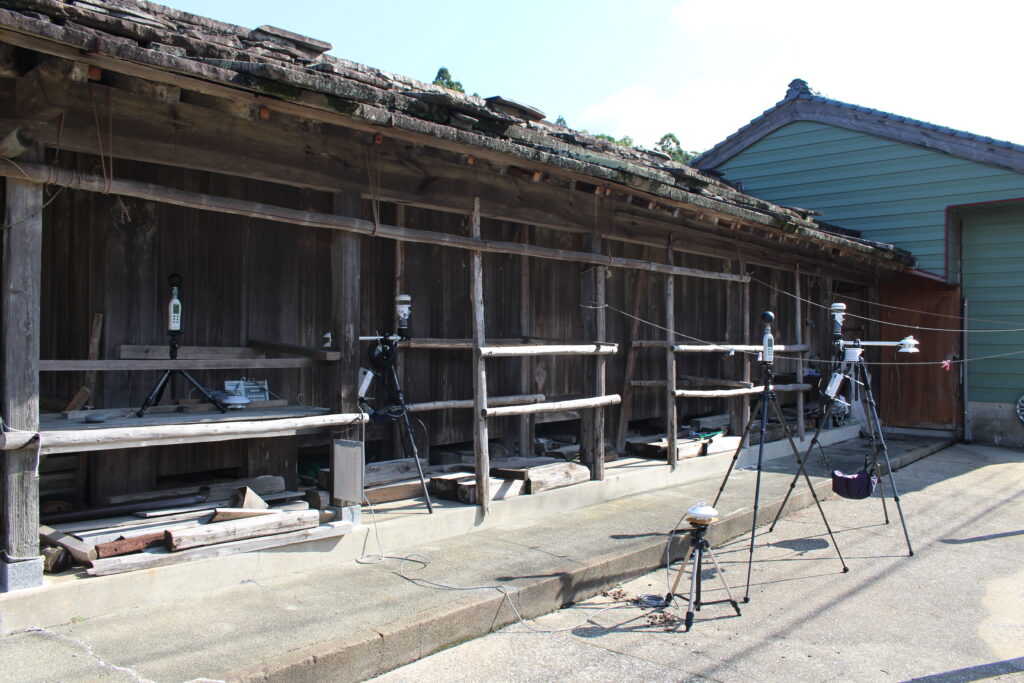
  

We installed measuring equipment in front of the stone-roofed coya.
Meijo University's Ishii Laboratory team installing measurement equipment.

Tokushima Survey September 2022

Continuing from last month, I went to Tokushima Prefecture to investigate mise-zukuri.

This is a joint investigation with Professor Watanabe of Daido University and Professor Ishii of Meijo University.

We have conducted actual measurements of the thermal environment and ultraviolet light environment.

According to the weather forecast beforehand, I was prepared for it to rain, but luckily it turned out to be sunny.

There was a typhoon on the way back.

It was a complete coincidence, but I was able to go and investigate at the right time.


Wind chimes are great for making mise!
Professor Watanabe and Professor Ishii setting up research equipment.

Open Campus

This is a story from a week ago.

Open campus was held face-to-face for the first time in three years.

There are many days of severe heat this summer, but fortunately it wasn't that hot on the open campus day, which was a relief.


I went to Iide Town!

I went to Iide Town in Yamagata Prefecture.

This time, we held a workshop to experience the summer thermal environment of Yashikibayashi.

Together with Professor Hama from Yamagata University and Professor Kurihara from Tohoku Institute of Technology, we had fun studying with the townspeople.

Third-year art students, Professor Kuroda of the World Heritage Studies degree program, and graduate students also participated.

Despite the intense heat with temperatures exceeding 35 degrees Celsius, we were able to confirm that the presence of palm trees lowered the WBGT (heat index) by more than 3 degrees Celsius.


In addition, we had the opportunity to observe the re-thatching work on a thatched roof and participate in a snow egg festival, among other activities.


A look at the trial session. Everyone experienced the WBGT meter and thermal imaging camera.
Where is it hot?Where is it cool?We talked about it in advance and made predictions before going there.
I was able to observe the re-thatching of a thatched roof.
This is the Snow Egg Festival.