Aizuwakamatsu Survey 2018 Summer Part XNUMX

This summer, heatwaves and heatstroke have been a hot topic in many places, and it was also hot in Aizuwakamatsu.

Temperatures sometimes exceeded 40 degrees between surveys.

Still, I felt quite comfortable when I was in the shade and the wind was blowing.

I realized once again the effectiveness of solar radiation shielding and ventilation.


This survey was a joint investigation between Professor Shinichi Watanabe's laboratory at Daido University and Professor Hitoshi Ishii's laboratory at Meijo University.

Last year and the year before, we conducted a joint survey on Amami Oshima, but this year we went to Aizu Wakamatsu.

The purpose is to evaluate the environment based on the perceived temperature using thermal environment indicators by observing temperature, humidity, airflow, and radiation.

Another unique feature is that ultraviolet light is observed at the same time.


Mr. Watanabe and Mr. Ishii took great measures to protect themselves from UV rays, but I didn't do much except wear a hat.

I got quite a sunburn.

During the day, the wind often blew from the west, and as a result, my left arm was more burnt.It may also be important to understand the distribution of UV rays by direction.

(The wind direction and speed are observed on the downwind side, so when the west wind blows, the left side of your body will face south.)


We used a former washing area to conduct observations along the waterway.So, how effective is the cooling effect of waterways? ? ?


The survey was completed successfully, and a commemorative photo was taken at the end.The students were also quite tanned, giving it a summery feel.

Aizuwakamatsu Survey 2018 Summer Part XNUMX

In early August, we conducted a field survey including small-scale climate observations in Futsukamachi Village, Kitaaizu-cho, Aizuwakamatsu City.

Characteristic landscape elements include the forest of mansions, waterways, and stone walls scattered throughout the village, which function not only as environmental regulators but also as flood prevention measures.

There are many old-fashioned houses with thatched roofs covered with corrugated iron, as well as attached buildings such as storehouses and barns.

A survey was previously conducted in this village in 2013.

We conducted a survey of the building layout within the village and a small winter climate observation survey, and confirmed that the mansion forest and attached buildings are arranged in a way that protects the village from the winter seasonal winds, and that a certain degree of windproofing effect can be expected.

Futake Sato, who was a core member at that time, went on to earn a doctoral degree, served as an assistant professor at the University of Tsukuba, and is currently an assistant professor at Meijo University.

It's already been five years since then.


Unfortunately, Yashikimori seems to be on the decline since then, but the water in the canals is said to be cleaner than before.

By verifying the effects of environmental design that has been accumulated in traditional villages, we hope to not only maintain traditional landscapes but also come up with ideas and proposals for new design methods.

Futsukamachi village.It is dotted with mansion forests.
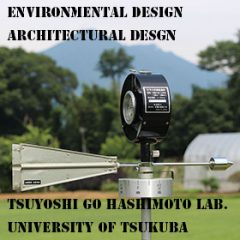
Observe the wind with a Biram anemometer.


Related papers:

Futake Sato, Tsuyoshi Hashimoto, Hisashi Toyokawa, Hitoshi Ishii: Principles of village structure of traditional villages in preparation for seasonal winds and floods and the windbreak effect of Yashiki-mori, Journal of the Japanese Society of Biometeorology, Vol. 52, No. 4, pp. 185- 197, 2015

Futake Sato, Tsuyoshi Hashimoto: Recent changes, maintenance, and inheritance of mansion forests at the village scale in complex alluvial fans, Architectural Institute of Japan Planning Journal, Vol. 81, No. 722, pp. 889-898, 2016